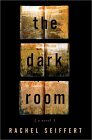
The Dark Room
by
Rachel Seiffert
Americas
Africa
& Asia
Europe
|
Can the past yield itself to us more freely as it recedes? Two absorbing debut novels set out to map new terrain within the far-reaching, ever-shifting minefield of writing related to the Nazi era. Both of these portraits, drawn in starkly contrasting tones, argue with grace and candour for the need to hold and turn over in our hands history's more unlikely protagonists. Told from the periphery of World War II, these two remarkable new works circle towards rather than insist upon the momentous.
Rachel Seiffert, author of The Dark Room, is a thirty-year-old English woman living in Germany whose triptych of three generations of Germans confronts the willful blindness and silences surrounding fascism.
Helmut, kept from fighting in the war because of a physical deformity, works as a photographer's assistant in 1930's Berlin. Drawn to the grandeur of the new architecture and the Reich's progressive rhetoric, he begins to chronicle the city, its new train terminals, proud citizens and flowing red banners. However, his acute eye for capturing movement and crowds notices a slow evacuation of the city as Nazi expansion shifts into gear. And Helmut diligently continues to record the subsequent details as Berlin is emptied of its youth, bombed and ultimately occupied. Confined to the camera's field of vision, Helmut steadfastly guards his pride in the Reich even as tanks roll into the city.
The middle section tells the harrowing journey of five suddenly homeless siblings as the war ends. Led by Lore, the eldest daughter, they cross four occupied zones in search of their grandmother, after their parents, both party members, have been interned. Continually on the verge of starvation, they accept the help of a fellow refugee (a survivor of Buchenwald), and the reality of the Holocaust slowly etches itself into Lore's awareness.
|
Finally, Micha is a young German teacher driven to unearth the truth about his grandfather's wartime activity. Set in the late 1990's, Micha is unnerved by the way they commemorate the liberation of the camps each year at his school. "The students read survivors' accounts. Everyone cries these we-didn't-do-it tears. Then the essays get marked, the displays are packed away, and we move right on to the next project." A hitherto ignored doubt regarding his beloved grandfather's nine-year imprisonment in Russia following the war becomes a consuming need to know. As Micha travels to Belarus in order to find and expose the unknowable, Seiffert's sober eloquence builds to an emotionally indelible climax.
|
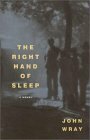
In contrast, The Right Hand of Sleep is a far more lyrical, ambitious, if slightly self-conscious, look into the moral ambivalence of the Nazi era. John Wray is an American of Austrian descent whose mother's family history figured prominently in the underpinning of the book. The novel's hero, Oskar Voxlauer, returns to his hometown in Austria twenty years after having deserted the Austro-Hungarian Army and fled to Russia towards the end of the Great War. The opening section brilliantly evokes Faulkner with its shifting narrative, shuttling between his life in Russia as a devout Communist and husband to his re-entry, disillusioned and bereaved, into an Austria on the brink of annexation.
Voxlauer's attempt to forget the tremors of the past--his father's suicide, his wife's death, the trench nightmares and brutal killings--by exiling himself to the bucolic hills outside the town is refused at every turn by the growing hatred around him. As Voxlauer's self-imposed exile becomes ever more compromised by a new love affair, the need to defend an old friend, and an increasingly menacing SS, Wray deftly balances an intricate mixture of political intrigue, ardour for nature, and moral consequence with true precision. From the period tone of dialogue to the cinematic flashbacks, Wray pushes his novel precariously close to pastiche only to rescue it brilliantly every time.
Born in the same year (1971), Seiffert and Wray have written novels of integrity, seriousness, and abundant beauty devoid of any sentimentality or irony. A true feat in any age--but particularly ours.
Fionn Meade 
|
The Right Hand of Sleep
by
John Wray
Americas
Africa
& Asia
Europe
|
|